Car keys · Stayner
Transponder Key Programming in Stayner
The blade snapped off flush with the door lock last winter, and the shop that cut a replacement only matched the metal shape. The fob still locks and unlocks the doors from across the driveway, but the engine cranks over and over without ever catching.
Transponder Key Programming
In plain words
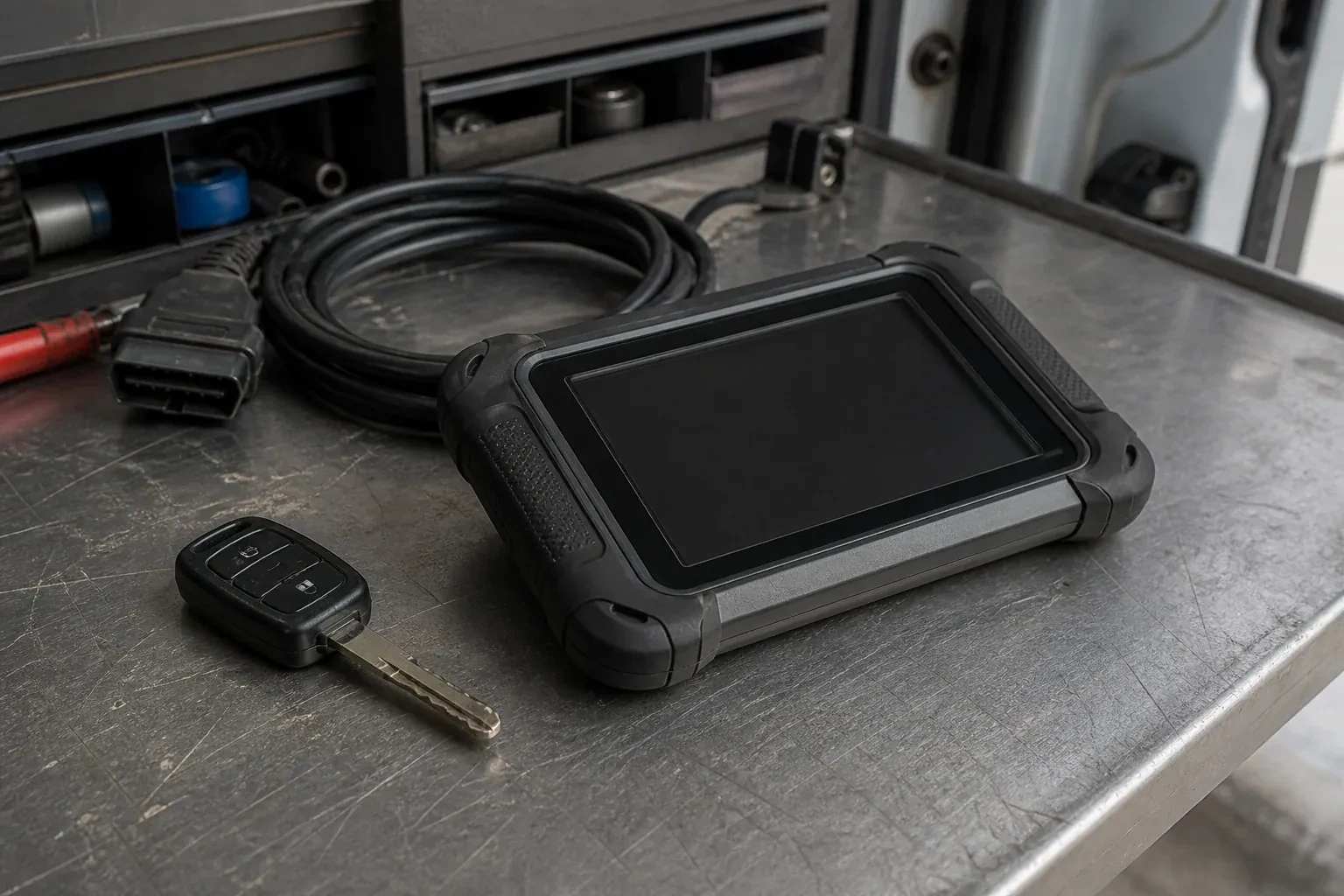
Transponder key programming is the step that teaches a vehicle's immobilizer to recognize a key's chip so the engine agrees to start, separate from cutting the metal blade that opens the door. A locksmith identifies the vehicle's own security system, connects programming equipment to it, and writes the new key's identity into its memory. Whether the job is a single spare, a replacement for a lost key, or every key gone at once, the visit ends the same way: the engine is started with the finished key, not just tested on a screen.
How the visit goesThe remote fob has gone silent, the doors won't unlock with a button press, and the little emergency blade tucked inside it has not been used since the day the car was bought. Nobody remembers exactly where the metal edge is supposed to go once it's out.
Stayner
How the visit goes
Whether the lock and the immobilizer agree
A key has two jobs: turning the mechanical lock and satisfying the electronic immobilizer, and the two are checked separately before any programming starts. A blade can be cut perfectly and still fail the second test if the wrong chip family ends up in its head. Confirming both together, rather than assuming a good mechanical fit means the electronics will follow, is what keeps a finished key from turning the lock politely while leaving the engine exactly as unresponsive as it was.
Starting over when every key is gone
All-keys-lost work follows a different path, because there is no working key left to prove the vehicle's trust to a new one. The locksmith first re-establishes secure access to the immobilizer's own module, sometimes through the vehicle's manufacturer network, before a fresh key list can be written at all. Once that access is confirmed, the new key or keys are added the same way any other key would be, and the process finishes with the same start-up test as a routine replacement.
Looking after the chip
The chip inside a key head has no moving parts and asks for very little, but it does not tolerate being separated from the blade by force. A key that gets bent, snapped, or pried at with tools meant for a different job can lose its chip along with its shape, and a chip cut in half no longer answers anything. Carrying the key on a ring rather than loose in a pocket, and keeping it away from repeated hard impacts, is most of what looking after it involves.
Transponder Key Programming
In the van
- Frequency test reader
- Security-access module
- Proximity smart key
- Diagnostic laptop or tablet
- Bench programming adapter
What affects the quote
Same fees day, night or weekend
1Trim or dash removal some models need for access
A small number of vehicles place the antenna ring or module somewhere that needs a panel or trim piece moved for a clear connection, which adds a step beyond the programming itself on those specific models.
2Type of key: blade, remote-head or proximity
A basic transponder blade, a remote-head key with buttons, and a push-button proximity key each involve a different amount of pairing beyond the immobilizer chip itself, which affects both the parts involved and the time the visit takes.
3Number of new keys requested
One replacement key is a smaller task than several keys for several drivers cut and programmed in the same visit, even though the underlying process for each additional key is largely the same.
Transponder Key Programming: questions
Can I have a spare key made before I actually need one?
Yes, and on many vehicles it is one of the more straightforward visits in this service, since a working key already on hand can authorize the new one; a few models instead call for two working keys or a different programming route. The spare is cut, its chip is written in, and both keys are tested before the locksmith leaves, so the spare is proven rather than simply handed over untested.
Do I need paperwork from the dealer, or a code from them?
Not usually. Programming equipment reads and writes the vehicle's key list directly in most cases, without needing anything from the dealer. Many recent vehicles gate that access behind a manufacturer-level security session instead, which the locksmith handles as part of the visit rather than asking the owner to obtain anything in advance.
How many keys can one vehicle hold in its memory?
It varies by make and model; some systems hold only a handful of identities, while others allow considerably more. Many vehicles let one working key on hand authorize adding another, though some ask for two working keys and others use a different programming route entirely, which is why all-keys-lost situations are handled differently from adding a spare or a second driver's key.
Car Keys
- Car Key ReplacementThe only key to the car went into the lake with the kayak.
- Spare Car Key DuplicationA car sits at the cottage all season, and the only key to it lives on a ring three hours away in…
- Key Fob ProgrammingA cracked case or a spin through the wash left the fob unresponsive, and opening it up reveals a…
Transponder Key Programming near you
A locksmith's week in Stayner is a mix of small fixes and bigger decisions. A cylinder rekeyed after a lost key, a deadbolt added to a door that never had one, a shop rekeyed after staff changes, a safe that finally opens. The pages below describe each service and how the visit usually goes.
- Wasaga Beach
- Clearview
- Midland
- Penetanguishene
- Creemore
- Brocks Beach
- New Wasaga Beach
- Oakview Beach
- Oxbow Park
- Firth's Corners
- Portage Park
- Sunnyside
- Dunedin
- Glen Huron
- Singhampton
- Balm Beach
- Coutnac Beach
- Edmore Beach
- Georgian Heights
- Kettle's Beach
- Marygrove
- Ossossane Beach
- Perkinsfield
- Sawlog Bay
- Wahnekewaning Beach
- Woodland Beach