Commercial · Dunedin
Panic & Exit Hardware in Dunedin
Two doors used to swing as a pair at the community hall entrance, but one leaf has started closing before the other, catching the astragal and leaving a gap wide enough to worry the caretaker.
Panic & Exit Hardware
In plain words
The visit ends with a record, not just a working door. Every device fitted is logged with its type, its rating, the force and latch checks it passed, and who now holds the dogging key. That record is what a fire inspector, an insurer or a new property manager asks for later, and it is far easier to hand over on the day of installation than to reconstruct afterward from memory of what went on which door.
How the visit goesThe daycare wants the yard gate and the classroom door alarmed so a staff member hears the moment it opens, without turning either into something a child could be shut behind.
Dunedin
How the visit goes
Occupancy, fire rating and the authority reviewing the space
The assessment records the occupancy type and calculated occupant load for the room the door serves, whether the door sits in a fire separation, and who the authority having jurisdiction is likely to be, whether that is a fire inspector, a building official or an insurer. These facts, not the door's appearance or its width alone, are what decide whether a releasing device is required, whether it must also be fire-rated exit hardware, and what documentation the finished installation should carry.
Handling a pair of doors
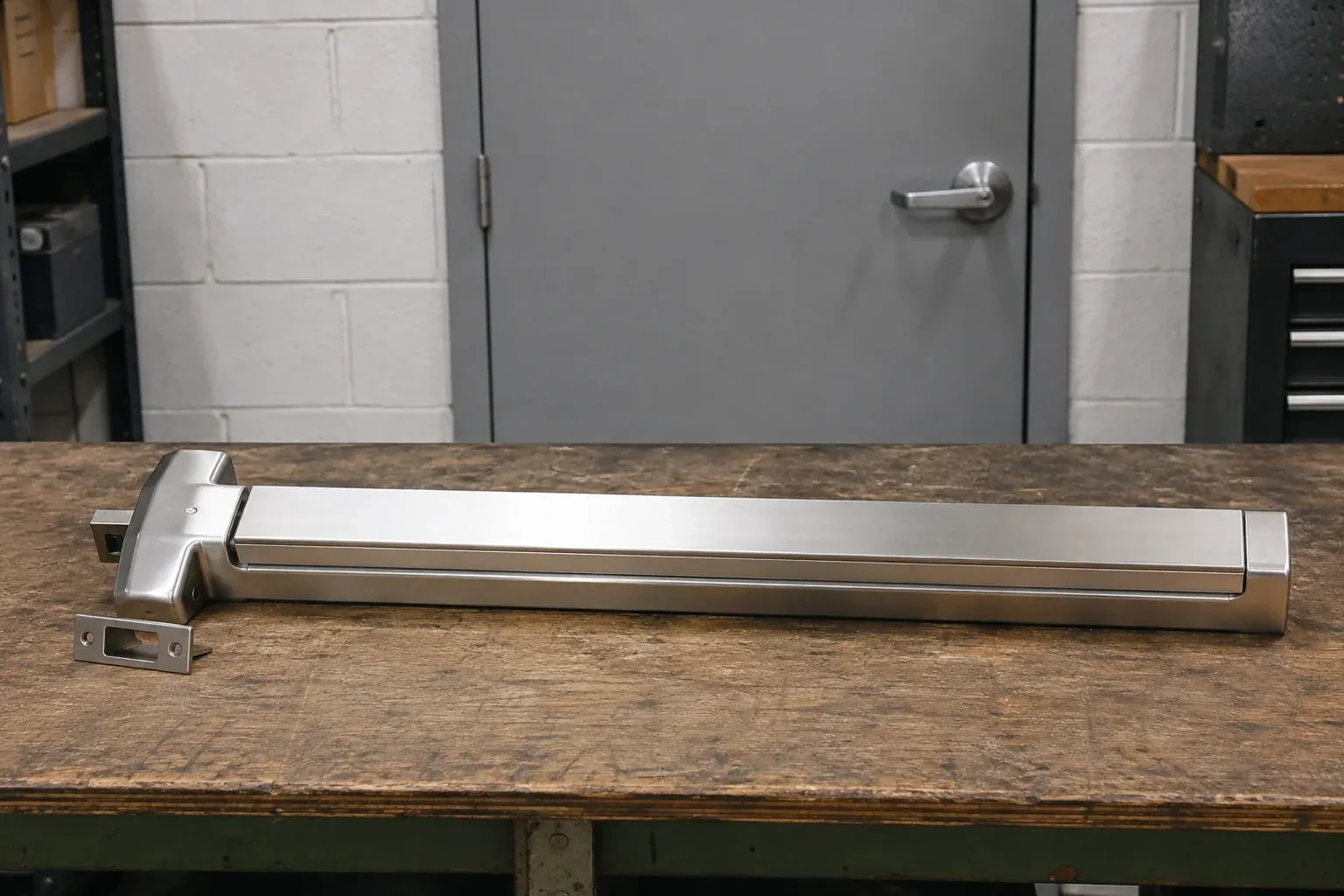
On a pair, a coordinator is fitted only where the hardware needs the leaves to close in a set order, letting the active leaf's device seat into the strike or into an astragal carried on the inactive leaf; many pairs latch independently and skip this step entirely. Where the plan calls for one wide exit instead of two narrow ones, the centre mullion is removed and vertical-rod devices are fitted to each leaf instead, arranged so both close and latch reliably. Either way, both leaves are tested together, not only on their own, before the visit is called finished.
A written record for the next review
The building now has a document naming every device fitted, its rating, the trim and any electrified function, and the tests each assembly passed on installation day. That record is what a fire inspector, an insurance reviewer or a new facilities manager will ask for, and having it ready saves reconstructing the history of a door from memory or from whatever sticker happens to still be on the case. It is worth keeping with the building's other life-safety paperwork.
Panic & Exit Hardware
In the van
- Outside trim (pull, lever or cylinder)
- Request-to-exit switch
- Signage and labels
- Dogging key or keyed cylinder
- Through-fixings and mounting hardware
What affects the quote
Same fees day, night or weekend
1Access-control integration
Where the door ties into an existing access-control panel, coordinating the exit hardware's signals with that system takes planning with whoever maintains it, which the quote accounts for separately from the device itself.
2Door and frame condition
A door that has sagged, a frame that has shifted, or a strike pocket that no longer lines up needs correcting before hardware is fitted, which adds its own line to the quote.
3Number of openings involved
One door with a single device is the simplest case. A building with several affected exits, such as doors from a stairway plus an assembly-room exit, is quoted as the sum of each opening's own work.
Panic & Exit Hardware: questions
Do exterior exit doors need anything different from interior ones?
An exterior device faces weather an interior one does not: temperature swings, moisture and road salt tracked up to the door in winter. The device, strike and trim chosen for an exterior opening account for that exposure, and more frequent cleaning and light lubrication keeps an exterior crossbar releasing smoothly through a whole winter season.
When does a door actually need this hardware rather than a regular lock?
It comes down to occupancy and occupant load rather than preference. Rooms used for assembly, such as banquet halls, places of worship or gyms, and doors serving a stairway in a busier building, are where this hardware becomes the standard choice instead of a keyed lock on the exit side. A fire inspector or building official is the practical way to confirm whether a specific room has crossed that line.
Can I add a request-to-exit switch for my access-control system?
Yes. A request-to-exit switch is wired to signal the access-control panel that the pushpad or crossbar was actuated. Telling that apart from a forced or propped door usually means pairing it with a door-position contact and the panel's own logic, since the switch on its own only reports that the hardware was used. It sits alongside the mechanical device without changing how the crossbar or touchpad works, so the door still releases under a push even if the access-control system loses power.
Commercial Locks
- Master Key System DesignA new hire at the shop gets handed whatever spare key happens to be in the drawer, and it turns out…
- Access Control InstallationYou just leased the empty unit next door and want the new tenant to open their own suite without a…
- Commercial-Grade Lock ReplacementHead office wants every branch keyed alike under one system, and half the locations are still…
Panic & Exit Hardware near you
Homes and businesses in Dunedin tend to need the same handful of things from a locksmith, so that is how the list is arranged: emergency openings, changing or rekeying locks, stronger hardware for people who want it, commercial doors and access, and safes. Car keys sit at the end for the households that need them.
- Wasaga Beach
- Clearview
- Midland
- Penetanguishene
- Creemore
- Stayner
- Brocks Beach
- New Wasaga Beach
- Oakview Beach
- Oxbow Park
- Firth's Corners
- Portage Park
- Sunnyside
- Glen Huron
- Singhampton
- Balm Beach
- Coutnac Beach
- Edmore Beach
- Georgian Heights
- Kettle's Beach
- Marygrove
- Ossossane Beach
- Perkinsfield
- Sawlog Bay
- Wahnekewaning Beach
- Woodland Beach