Change or rekey · Stayner
Deadbolt Installation in Stayner
The front door has a handsome lever and a keyed knob, and that is all. Nothing above it.
Deadbolt Installation
In plain words
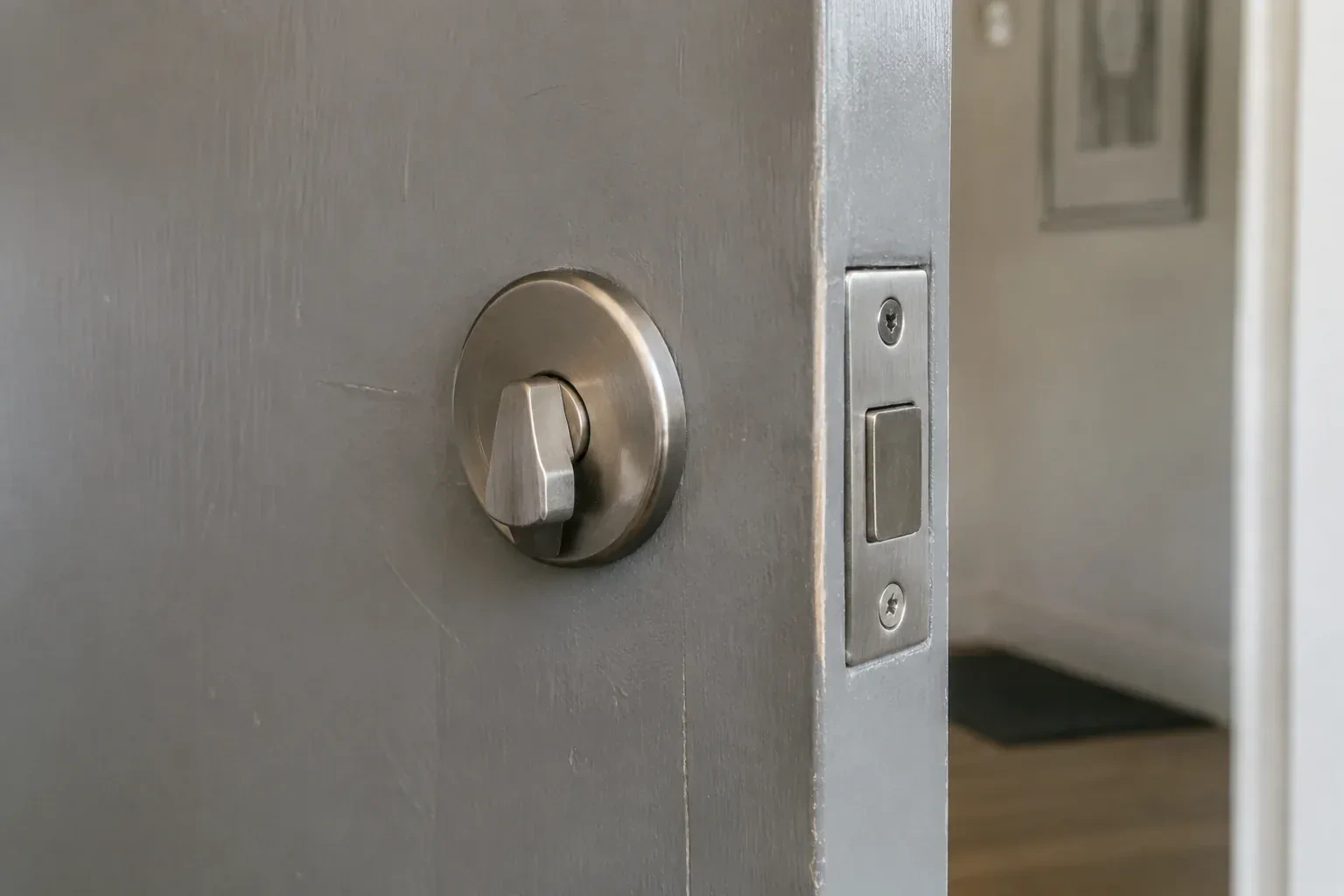
Most of the value in a deadbolt is on the frame side, which is why a good installation spends as much time on the jamb as on the door. The bolt is only as strong as the pocket it throws into and the screws that hold the strike. Short screws in a standard strike bite only into the thin jamb board; a reinforced strike fastened with 75 mm screws passes through that board into the stud behind, so a blow against the door meets the house rather than a strip of pine. The pocket is cut deep enough for a full throw and aligned so the bolt slides home freely.
How the visit goesYou bought a keypad deadbolt online and pulled the old one off, only to find the hole in the door is a different size and the bolt latch sits at a backset the new kit does not list. The door is now open and the box is on the counter.
Stayner
How the visit goes
Measuring the bore and the backset
Deadbolts are built around two dimensions. The cross bore is the large hole through the face of the door, 54 mm on most residential hardware, though some older or imported locks used 38 mm. The backset is the distance from the door edge to the centre of that hole, 60 mm or 70 mm on nearly every door in this part of the world. If a deadbolt is being replaced, both are measured so the new lock lands in the existing holes without a shim or a gap. On a new installation they are chosen to match the knob below, so the two locks line up and any future keypad or smart deadbolt drops straight in.
Assembling the cylinder and thumb-turn
The outside housing goes on first, with its tailpiece threaded through the slot in the bolt cam and its mounting posts through the matching holes. Any plastic alignment bracket that ships with the lock is used on a 54 mm bore and removed on a smaller one. The inside thumb-turn plate is set against the door and the two long tapered screws are driven through it into the outside housing, snug rather than crushed, so the housings pull tight to the door without distorting the mechanism. The locksmith turns the thumb-turn before the door is closed to confirm the bolt throws its full length and returns without a catch.
A frame that now holds the bolt
Behind the new strike plate is the part of the job you cannot see and will never need to think about. The pocket has been bored deep enough for the bolt to seat fully, the plate has been let into the jamb so it sits flush, and the long screws reach through the jamb into the framing behind it. On a door that had been forced or had stripped screw holes, a full-length reinforcer may sit under the strike. If you press the jamb with your palm now, it does not flex. That stiffness is what a bolt needs to do its work, and it is the reason the installation took as long on the frame as on the door.
Deadbolt Installation
In the van
- Jamb reinforcer
- 75 mm (3 in) strike screws
- Manufacturer's bore template
- Rekeying pins and key blanks
- Boring jig and 54 mm hole saw
What affects the quote
Same fees day, night or weekend
1Hardware supplied by you or by the locksmith
If you have already bought the lock, the quote covers labour and any adaptation of the door to that kit. Hardware supplied from the van is listed separately with its grade and finish.
2Number of doors
One front door is the simplest case. Front, back, side and garage-to-house doors done in one visit share the travel and setup, so the per-door figure usually eases as the count rises.
3Keying alike or a fresh key
Pinning the new cylinder to your existing key, or setting several doors to a new key, is bench work quoted per cylinder, plus the number of keys you ask to have cut.
Deadbolt Installation: questions
Why does the strike plate matter so much?
The strike is the metal plate the bolt throws into, and it is where a kicked door usually fails: short screws bite only into the thin jamb board, which splits. A reinforced strike or strike box fastened with 75 mm screws passes through the jamb into the stud behind, so a blow is met by the framing of the house. On a wood frame, strike screws that reach at least 30 mm into solid wood behind the jamb are what actually holds.
Does a deadbolt work with a storm door or screen door?
It does, with one check: the thumb-turn and the outside cylinder have to clear the storm door when it closes. Most storm doors leave enough depth, but a low-profile deadbolt trim is chosen where the gap is tight. The storm door's own latch is separate and does not replace a bolt on the main door, since a screen frame gives little resistance on its own.
Can a keypad or smart deadbolt be fitted instead of a keyed one?
Yes, and the preparation is the same. Many electronic deadbolts use the standard 54 mm bore and the same edge bore, so a door cut for a mechanical bolt often accepts one, and a keyed bolt fitted today can usually be swapped for a keypad later, subject to that model's own bore, backset and thickness needs. The locksmith checks door thickness against the model, fits a reinforced strike as usual, sets up codes with you and shows where the backup cylinder or battery terminals are.
Change or Rekey Locks
- Lock Replacement & UpgradeThe brass handleset has gone blotchy and green where the winter salt reaches it, and the coating on…
- Vintage Mortise Lock ServiceThe old skeleton key still fits the keyhole, but it now needs a jiggle, a lean on the door and a…
- Smart Lock InstallationHalf the evenings someone asks whether the back door got locked, and nobody is sure.
Deadbolt Installation near you
A locksmith's week in Stayner is a mix of small fixes and bigger decisions. A cylinder rekeyed after a lost key, a deadbolt added to a door that never had one, a shop rekeyed after staff changes, a safe that finally opens. The pages below describe each service and how the visit usually goes.
- Wasaga Beach
- Clearview
- Midland
- Penetanguishene
- Creemore
- Brocks Beach
- New Wasaga Beach
- Oakview Beach
- Oxbow Park
- Firth's Corners
- Portage Park
- Sunnyside
- Dunedin
- Glen Huron
- Singhampton
- Balm Beach
- Coutnac Beach
- Edmore Beach
- Georgian Heights
- Kettle's Beach
- Marygrove
- Ossossane Beach
- Perkinsfield
- Sawlog Bay
- Wahnekewaning Beach
- Woodland Beach