Lockouts · New Wasaga Beach
Broken Key Extraction in New Wasaga Beach
The padlock on the shed has been stiff all summer. Today the key twisted, cracked at the tip, and left the end buried deep in the keyway.
Broken Key Extraction
In plain words
Freezing is one of the bigger seasonal causes of broken keys here. Meltwater runs into the keyway during a thaw and freezes overnight, so the plug is locked in ice, and most people respond by turning harder. The blade gives before the ice does. A winter extraction visit therefore begins with thawing: lock de-icer or gentle warmth frees the plug, then the fragment is drawn out and the cylinder is dried and given the lubricant its maker specifies. You leave with the piece out, a new key cut, and a small tube of de-icer so the next frozen morning is a pause rather than a snap.
How the visit goesThat key had been bending a little for years, and you kept straightening it. Today it finally cracked at the deepest cut. The stub is in the lock, and the spare you found goes in a few millimetres and stops against it.
New Wasaga Beach
How the visit goes
How the piece is sitting
The first look is at the fragment itself, without touching it. Does any of the blade show above the cylinder face, or is it flush or deeper still? Is the plug sitting at its normal rest position, or did it stop partway round when the key gave way? A protruding piece in a resting plug is the simplest case. A fragment past the shear line in a rotated plug means the pins are holding it, and the plug has to be brought back before anything will slide. Reading this correctly decides which extractor comes out of the case and spares the keyway from needless probing.
Drawing it out with a hook extractor
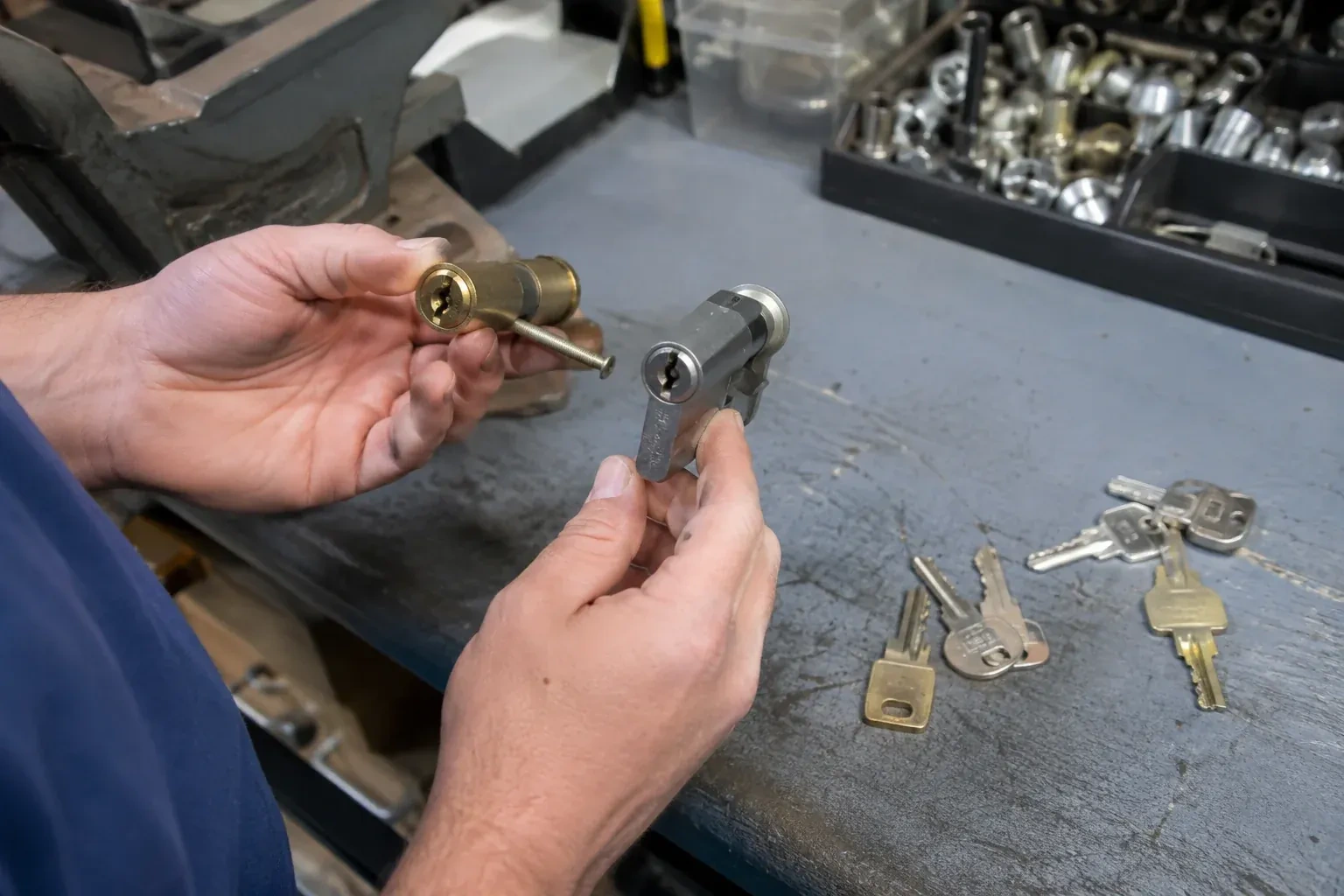
Every keyway has grooves, called wards, that run along its length above and below the blade. A hook extractor is a slim strip of spring steel thin enough to ride in one of those grooves beside the fragment. The locksmith slides it in past the broken piece, rotates it slightly so the barbed tip catches a cut in the blade, and draws it back out in a straight line. The pins are lifted clear as the piece passes them, exactly as they are when a key is withdrawn. It is a patient, felt process, and the cylinder is untouched by it.
Habits for the freezing months
A winter break leaves you with a dried, lubricated cylinder and one rule: when the key stops partway, you stop too. Carry a small lock de-icer in a coat pocket or the glovebox; a few seconds of it, or the warmth of a cupped hand on the cylinder, frees a frozen plug without asking anything of the blade. Shut the storm door before freezing rain, and fit a keyhole cover on a side door that catches meltwater during a thaw. Ice is one of the winter causes the locksmith sees often, alongside worn keys, misalignment and dirty or worn cylinders, and it is one of the easiest to prevent.
Broken Key Extraction
In the van
- Fine-jawed extractor pliers
- Key gauge and decoder
- Tension tool for resetting the plug
- Replacement cylinder or deadbolt
- Manufacturer-approved cylinder lubricant
What affects the quote
Same fees day, night or weekend
1Rekeying other doors to match
If the cylinder ends up rekeyed or replaced, matching the other exterior locks to the new key is priced per cylinder, and simplest while the locksmith is already there.
2Locked or unlocked door
If the door is locked, the extraction is followed by opening it, which is quoted as its own part of the visit. If the door is open, the work is extraction and securing.
3Drilling and a replacement cylinder
On the rare occasion a cylinder must be sacrificed, the price includes the new cylinder or complete deadbolt plus fitting it, and that is agreed with you before the drill is picked up.
Broken Key Extraction: questions
Why do keys break more in winter?
A daytime thaw sends meltwater into the keyway, and overnight it freezes with the plug held solid. The key goes in, meets resistance, and the natural reaction is to turn harder. Brass gives before ice does, especially at a deep cut that has thinned over years. Cold also stiffens old grease in the cylinder. De-icer, gentle warmth and a dry lubricant break the pattern.
What information helps when I call?
What the key was in: a front door deadbolt, a knob, a padlock, the driver's door or the ignition. Whether any of the key shows above the face. Whether the key turned before it broke and whether the door is locked now. Whether anything has been inserted since. Whether you have the other half, a spare or the key code. And whether the property is owned, rented or managed.
What proof do I need to show?
Photo identification and something that connects you to the lock. For a house or apartment that is a lease, a bill, addressed post, or confirmation from the property manager; for a business, your role there; for a vehicle, the registration or ownership papers with matching identification. If the documents are inside, say so on the phone and the check is completed once the door is open.
Lockout Services
- Business Lockout ServiceA cook stepped into the alley with the recycling and the rear door swung shut behind him.
- Break-In Damage Lock RepairThe shop's aluminum door has a bent meeting stile and the hookbolt is jammed half out.
- Seized & Jammed Lock OpeningYou are inside, the deadbolt is thrown, and the thumb-turn will not budge.
Broken Key Extraction near you
A locksmith's week in New Wasaga Beach is a mix of small fixes and bigger decisions. A cylinder rekeyed after a lost key, a deadbolt added to a door that never had one, a shop rekeyed after staff changes, a safe that finally opens. The pages below describe each service and how the visit usually goes.
- Wasaga Beach
- Clearview
- Midland
- Penetanguishene
- Creemore
- Stayner
- Brocks Beach
- Oakview Beach
- Oxbow Park
- Firth's Corners
- Portage Park
- Sunnyside
- Dunedin
- Glen Huron
- Singhampton
- Balm Beach
- Coutnac Beach
- Edmore Beach
- Georgian Heights
- Kettle's Beach
- Marygrove
- Ossossane Beach
- Perkinsfield
- Sawlog Bay
- Wahnekewaning Beach
- Woodland Beach