Change or rekey · Portage Park
Deadbolt Installation in Portage Park
The front door has a handsome lever and a keyed knob, and that is all. Nothing above it.
Deadbolt Installation
In plain words
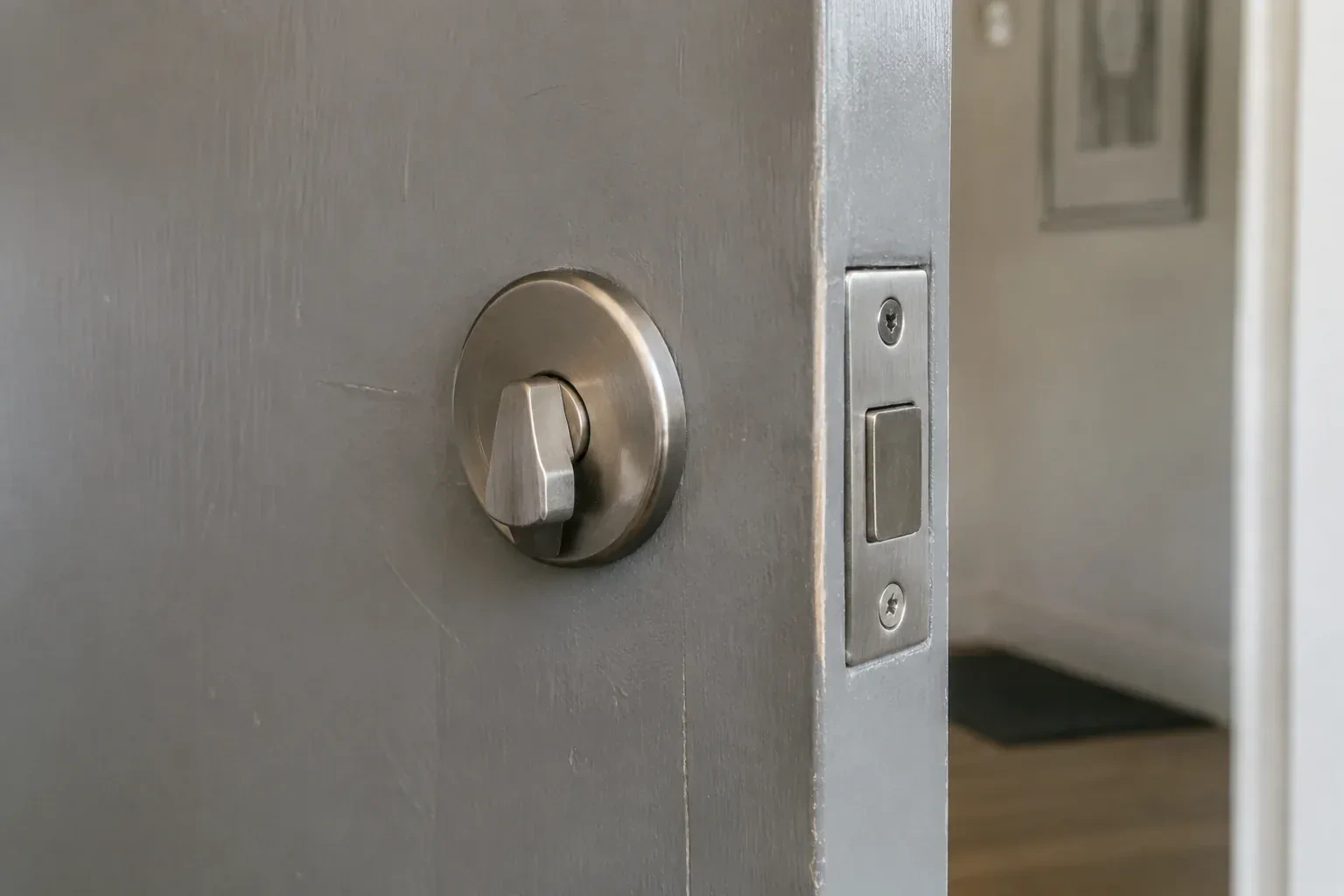
Most of the value in a deadbolt is on the frame side, which is why a good installation spends as much time on the jamb as on the door. The bolt is only as strong as the pocket it throws into and the screws that hold the strike. Short screws in a standard strike bite only into the thin jamb board; a reinforced strike fastened with 75 mm screws passes through that board into the stud behind, so a blow against the door meets the house rather than a strip of pine. The pocket is cut deep enough for a full throw and aligned so the bolt slides home freely.
How the visit goesThe back door has a deadbolt in name only: a short bolt, a thin brass strike held by two little screws, and a jamb you can flex with your palm. It was fine for a builder's showing. It is not fine for a laneway.
Portage Park
How the visit goes
Where the bolt should sit on the door
On a door with no deadbolt yet, its height is not fixed by the manufacturer but by the door in front of you. The usual spot is 140 to 150 mm above the centre of the knob, which places the bolt near the strongest part of the lock stile and keeps both locks within one comfortable reach. The locksmith checks that this height misses any glass, decorative panel, hinge line or the wood block inside an insulated door, and that the frame behind that spot is solid rather than a gap between shims. If a storm door or screen door shares the opening, the bolt's thumb-turn and cylinder have to clear it as well.
Fitting the bolt and setting the backset
The bolt assembly slides into the edge bore with the faceplate set the way its maker marks, commonly the word "top" facing up. Most residential bolts adjust between 60 mm and 70 mm by twisting or sliding the faceplate, and the locksmith sets it to the backset measured earlier so the tailpiece from the cylinder lands in the centre of the bolt's cam. The bolt is secured with its two short screws, and the locksmith works it in and out by hand to feel that it runs freely through the door without rubbing on the bore. On an insulated door a round drive-in collar may replace the flat plate where the edge is too thin to mortise.
The rest of the door, tidied
A deadbolt installation usually leaves the whole entry better than it found it. Hinge screws that were loose have been replaced with longer ones that bite into the framing, so the door hangs square. Weatherstrip that pinched the door has been trimmed and the latch below the new bolt has been checked against its own strike. The bore edges are clean, any shavings and steel filings have been vacuumed from the sill and the core, and the finish around the new hardware is unmarked. Open and close the door a few times over the next week and let the locksmith know if anything changes as the door settles.
Deadbolt Installation
In the van
- Jamb reinforcer
- 75 mm (3 in) strike screws
- Manufacturer's bore template
- Rekeying pins and key blanks
- Boring jig and 54 mm hole saw
What affects the quote
Same fees day, night or weekend
1Door material
Solid wood, steel-clad and fibreglass doors are each cut differently. Metal skins call for slower cutting and cleanup of filings, so the material is one of the first things a quote takes into account.
2Travel to the property
Distance and access are part of any call-out: a house on a suburban street and a rural property down a long road involve different driving time, and the quote says so.
3Glass near the lock
A captive thumb-turn, laminated glass, security film or a relocated bolt height each carry their own cost, and the choice you make about glass shapes that part of the quote.
Deadbolt Installation: questions
Why does the strike plate matter so much?
The strike is the metal plate the bolt throws into, and it is where a kicked door usually fails: short screws bite only into the thin jamb board, which splits. A reinforced strike or strike box fastened with 75 mm screws passes through the jamb into the stud behind, so a blow is met by the framing of the house. On a wood frame, strike screws that reach at least 30 mm into solid wood behind the jamb are what actually holds.
Does a deadbolt work with a storm door or screen door?
It does, with one check: the thumb-turn and the outside cylinder have to clear the storm door when it closes. Most storm doors leave enough depth, but a low-profile deadbolt trim is chosen where the gap is tight. The storm door's own latch is separate and does not replace a bolt on the main door, since a screen frame gives little resistance on its own.
Can a keypad or smart deadbolt be fitted instead of a keyed one?
Yes, and the preparation is the same. Many electronic deadbolts use the standard 54 mm bore and the same edge bore, so a door cut for a mechanical bolt often accepts one, and a keyed bolt fitted today can usually be swapped for a keypad later, subject to that model's own bore, backset and thickness needs. The locksmith checks door thickness against the model, fits a reinforced strike as usual, sets up codes with you and shows where the backup cylinder or battery terminals are.
Change or Rekey Locks
- Lock Replacement & UpgradeThe brass handleset has gone blotchy and green where the winter salt reaches it, and the coating on…
- Vintage Mortise Lock ServiceThe old skeleton key still fits the keyhole, but it now needs a jiggle, a lean on the door and a…
- Smart Lock InstallationHalf the evenings someone asks whether the back door got locked, and nobody is sure.
Deadbolt Installation near you
Below, each lock and key service we offer in Portage Park gets its own page, with a description that assumes no prior knowledge. Start anywhere. Many customers arrive for a lockout and leave knowing exactly why the strike plate on the back door has bothered them for years.
- Wasaga Beach
- Clearview
- Midland
- Penetanguishene
- Creemore
- Stayner
- Brocks Beach
- New Wasaga Beach
- Oakview Beach
- Oxbow Park
- Firth's Corners
- Sunnyside
- Dunedin
- Glen Huron
- Singhampton
- Balm Beach
- Coutnac Beach
- Edmore Beach
- Georgian Heights
- Kettle's Beach
- Marygrove
- Ossossane Beach
- Perkinsfield
- Sawlog Bay
- Wahnekewaning Beach
- Woodland Beach